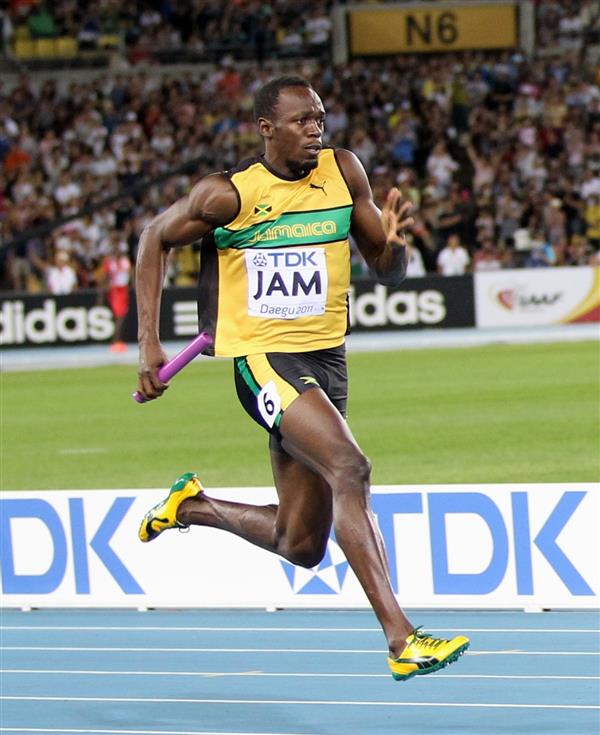
On the eve of the 2016 Rio Olympics, there were doubts about the health and fitness of the fastest man on the planet, Jamaica’s Usain Bolt. After all, he had an injury-plagued 2016 season, highlighted by his withdrawal from the Jamaican National Trial back on July 1. Bolt, who turned 30 years old on August 21, was perceived by his rivals to be vulnerable and the Olympics were a great opportunity to dethrone the sprint king. Heading into Rio, Bolt had won a combined 6 gold medals in the 2008 and 2012 Olympics and was on the verge of pursuing an unprecedented triple-triple or 9 gold medals.
The 6’5” Trelawny-born and Glen Mills-coached athlete would not be denied. Bolt retained his 100m title by coming from behind to beat American Justin Gatlin (9.89) and Canadian Andre De Grasse (9.91). Bolt winning time of 9.81 seconds (+0.2mps) was significantly slower than his personal best and world record time of 9.58 seconds.
Next for Bolt was the 200m, his favorite event. The only question was whether or not Bolt would threaten his 200m world record of 19.19 seconds. Bolt won the 200m in a season-best time of 19.78 seconds (-0.5mps) ahead of De Grasse (20.02) and Frenchman, Christophe Lemaitre (20.12).
Bolt was happy with the win but was visibly disappointed with his time. Perhaps the fact that the track was wet and that they were running into a headwind contributed to the “slow” time. Also, Bolt felt that he wasn’t being pushed hard enough throughout the race and the quick turnaround (85 minutes) between the semi-finals and finals lead to his “disappointing” time of 19.78 seconds. It should be noted that Bolt was the only athlete to go sub-20 seconds in this event.
Bolt then lead his Jamaican team of Nickel Ashmeade, Asafa Powell and Yohan Blake to victory in the men’s 4x100m relays in a season-best time of 37.27 seconds ahead of Japan (37.60) and Canada (37.64). The U.S. Team of Mike Rodgers, Justin Gatlin, Tyson Gay and Trayvon Bromell finished in third place but was later disqualified for running before the acceleration zone (IAAF Rule 170.7).
This was a fitting end to the Olympic exploits of the greatest sprinter ever. Nine Olympic events, nine gold medals, Bolt has remained undefeated in the finals of the all events he contested at the Olympics. Bolt has nothing left to prove on the track. In Brazil, where soccer is king, Bolt’s mere presence lead to a sold-out stadium, as Brazilians and the rest of the world were drawn to a great man, a legend, always anxiously waiting to see what he would do next. Bolt’s charm and infectious charisma had captivated and inspired people across the globe and has drawn people to the sport of track and field. For 10 days, during the athletics segment of the Olympics, people worldwide wanted to see what the Jamaican superstar would do and he certainly didn’t disappoint.
Bolt's performances during the 2008, 2012 and the 2016 Rio Olympics embody the three ideals of the modern Olympics movement. The three ideals or core values are respect, excellence and friendship. While being interviewed by a Spanish TV station at the 2012 London Olympics, Bolt stopped the interview to pay his respect to the playing of the American national anthem and continued with the interview only after the anthem ended. After winning the 200m title in Rio, Bolt could be seen celebrating not only with his nation’s flag (Jamaican) but also with the Brazilian flag. Bolt is fully aware of his role not only as a Jamaican athlete but also as an ambassador of the sport of track and field. His gesture showed an appreciation and respect for the Brazilian people and they in return showed their love for him.
Bolt, the man, the myth and the legend is set to retire next year after the 2017 London World Championship. His retirement will be a tremendous blow to the sport of track and field
Edited by Raymond Byfield
Usian Bolt picture taken by Ridley Ingram (SportingEventFotos.com)

Comments
Leave a Comment